
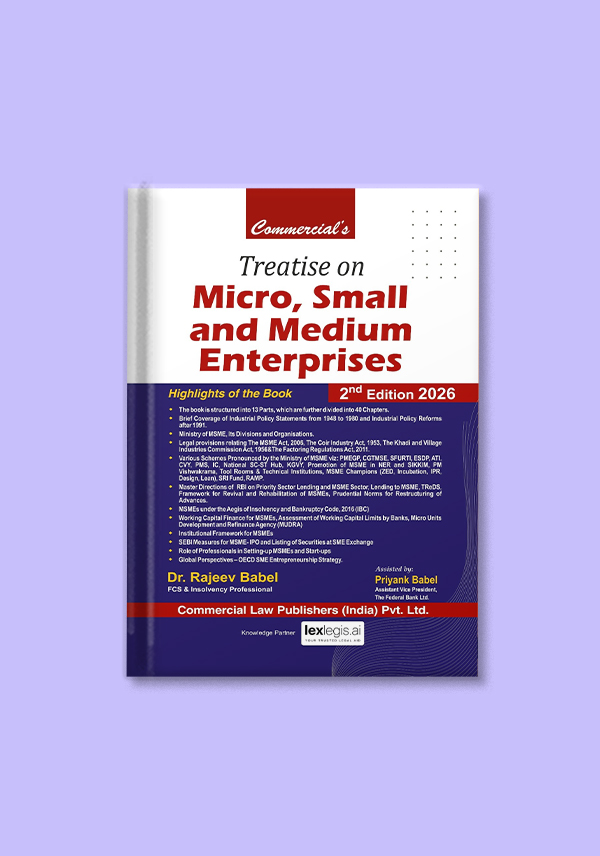
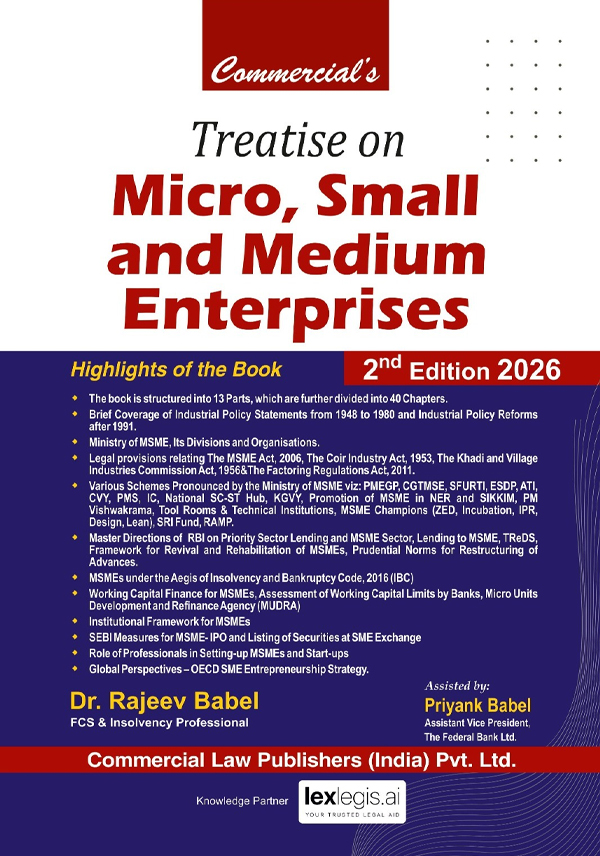
-
- Chapter 1—Industrial Policy Statements Since 1948 and Enactment
- of MSME Act, 2006 3
- Chapter 2—Ministry of MSME, its Divisions and Organisations 11
- Chapter 3—The Micro, Small and Medium Enterprises
- Development Act, 2006 (Act No. 27 of 2006) 31
- Chapter 4—Udyam Registration 86
- Chapter 5—MSME SAMADHAAN – Delayed Payments to
- Micro and Small Enterprises under MSME Act, 2006 91
- Chapter 6—Online Dispute Resolution (ODR) 98
- Chapter 7—The Coir Industry Act, 1953 (Act No. 45 of 1953) 113
- Chapter 8—The Khadi and Village Industries Commission Act, 1956
- (Act No. 61 of 1956) 134
- Chapter 9—Prime Minister Employment Generation Programme and
- Other Credit Support Schemes 163
- Chapter 10—Development of Khadi, Coir and Village Industries 203
- Chapter 11—Marketing Promotion Schemes 375
- Chapter 12—Technology Upgradation and Quality Certification 406
- Chapter 13—Entrepreneurship and Skill Development Programmes (ESDP) 471
- Chapter 14—Micro & Small Enterprises Cluster Development
- (MSE-CDP) 487
- Chapter 15—Schemes of National Small Industries Corporation (NSIC) 514
- Chapter 16—National SC-ST Hub 545
- Chapter 17—National Award Scheme 576
- Chapter 18—Technology Centres / Extension Centres (TCEC) 583
- Chapter 19—Scheme of Surveys, Studies and Policy Research
- (SS&PR Scheme) 585
- Chapter 20—Promotion of MSMEs in NER and Sikkim 595
- Chapter 21— MSE-SPICE (RAMP PROGRAMME) 603
- Contents at a Glance
- Chapter 22—Vishwakarma Scheme 615
- Chapter 23—Udyam Sakhi 640
- Chapter 24—Self-Reliant India (SRI) Fund 643
- Chapter 25—Tool Rooms & Technical Institutions 645
- Chapter 26—Master Directions of RBI – Priority Sector Lending and
- MSME Sector 651
- Chapter 27—Master Directions of RBI – Lending to MSME Sector 657
- Chapter 28—The Factoring Regulation Act, 2011 (Act No. 12 of 2012) &
- Regulations issued by RBI 680
- Chapter 29—Trade Receivables Discounting System (TReDS) 697
- Chapter 30—Revival and Rehabilitation of Micro, Small and Medium
- Enterprises 711
- Chapter 31—Prudential Norms for Restructuring of Advances 721
- Chapter 32—MSMEs under the aegis of the Insolvency and
- Bankruptcy Code, 2016 731
- Chapter 33—Credit Guarantee Fund Trust for Micro and Small
- Enterprises (CGTMSE) 759
- Chapter 34—Raising Finance from
- Lenders – Key Issues for MSME Borrowers 831
- Chapter 35—Assessment of Working Capital
- Finance by Banks to MSME – Recommendations of
- Various Committees 851
- Chapter 36—Micro Units Development and Refinance Agency Ltd.
- (MUDRA) 859
- Chapter 37—Institutional
- Framework for MSME 873
- Chapter 38—SEBI Measures for MSME – IPO and Listing of
- Securities at SME Exchange 887
- Chapter 39—Role of Professionals in Setting-up MSMEs and Startups 927
- Chapter 40—OECD SME and Entrepreneurship Strategy 933
- Contents
- Part I: Industrial Policy Statements Since 1948 and Enactment of MSME Act, 2006
- Chapter 1—Industrial Policy Statements Since 1948 and Enactment of MSME Act, 2006
- 1.1 Industrial Policy Reforms Before 1991 3
- 1.1.1 Industrial Policy, 1948 3
- 1.1.2 Industrial Policy, 1956 4
- 1.1.3 Industrial Policy, 1977 4
- 1.1.4 Industrial Policy, 1980 5
- 1.2 Industrial Policy Reforms After 1991 5
- 1.2.1 Industrial Policy, 1991 5
- 1.3 Evolution and Regulatory Framework for SMES – Journey towards the
- enactment of MSME Act, 2006 6
- 1.3.1 SME Development Bill, 2005 6
- 1.3.2 The Interest on Delayed Payments to Small Scale and Ancillary
- Industrial Undertakings Act, 1993 7
- 1.3.3 Enactment of the ‘Micro, Small and Medium Enterprises
- Development Act, 2006 (Act 27 of 2006) (MSME Act)’ 7
- 1.4 Role of MSME in Indian Economy 7
Part II: Ministry of MSME, its Divisions and Organisations
Chapter 2—Ministry of MSME, its Divisions and Organisations
- 2.1 Micro, Small and Medium Enterprises Sector 11
- 2.1.1 Khadi and Village Industries (KVI) 11
- 2.1.2 Coir Industry 11
- 2.1.3 Ministry of Micro, Small & Medium Enterprises (M/o MSME) 11
- 2.1.3.1 Enactment of MSME Act 12
- 2.1.3.2 Merger of Ministry of SSI and Ministry of Agro & Rural
- Industry to Ministry of Micro, Small and Medium
- Enterprises 12
- 2.1.3.3 Role of State Government in Promotion and Development
- of MSME 12
- xii CONTENTS
- 2.2 Organisational Setup of Ministry of MSME 13
- 2.2.1 Divisions 13
- 2.2.2 Office of the Development Commissioner 13
- 2.2.3 National Board for Micro, Small and Medium Enterprises (NBMSME) 13
- 2.3 Vision, Mission and Functions of Ministry of Micro, Small and Medium
- Enterprises 13
- 2.3.1 Vision 13
- 2.3.2 Mission 14
- 2.3.3 Functions 14
- 2.3.4 Schemes of the Ministry 14
- 2.4 Divisions of Ministry of MSME 14
- 2.4.1 AFI Division 14
- 2.4.2 SME Division 15
- 2.4.2.1 International Cooperation Section 15
- 2.4.2.2 SME Section 15
- 2.4.2.3 EDI Section 16
- 2.4.2.4 Women Entrepreneurship Cell (WEC) 17
- 2.4.2.5 Media Cell 17
- 2.4.3 Agro and Rural Industries (ARI Division) 17
- 2.4.3.1 Coir Section 17
- 2.4.3.2 KVI(I) Section 18
- 2.4.3.3 KVI (II) Section 19
- 2.4.3.4 PMEGP Section 19
- 2.4.4 Internal Finance & Budget 20
- 2.4.5 DBT Division 20
- 2.5 Organisations Attached with the Ministry of MSME 21
- 2.5.1 Office of Development Commissioner (MSME) 21
- 2.5.2 Khadi & Village Industries Commission (KVIC) 21
- 2.5.2.1 Objectives 21
- 2.5.2.2 Functions 21
- 2.5.3 Coir Board 22
- 2.5.3.1 Objectives 23
- 2.5.3.2 Functions 23
- 2.5.4 National Small Industries Corporation Ltd. (NSIC) 24
- 2.5.4.1 Objectives 24
- 2.5.4.2 Functions 24
- CONTENTS xiii
- 2.5.5 National Institute of Micro, Small and Medium Enterprises (NI-MSME) 25
- 2.5.5.1 Objectives 25
- 2.5.5.2 Functions 26
- 2.5.6 Mahatma Gandhi Institute of Rural Industrialisation (MGIRI) 26
- 2.5.6.1 Objectives 26
- 2.5.6.2 Functions 26
- 2.6 Training Institutes 27
Part III: MSME Act, Registration, Samadhan and Online Dispute Resolution
Chapter 3—The Micro, Small and Medium Enterprises Development
Act, 2006 (Act No. 27 of 2006)
3.1 Commencement and Definitions Prescribed Under the MSME Act – Chapter I 32
3.1.1 Short Title and Commencement – Section 1 32
3.1.2 Definitions – Section 2 32
3.2 National Board for Micro, Small and Medium Enterprises—Chapter II
(Section 3 to 6) 42
3.2.1 Establishment of Board – Section 3 42
3.2.1.1 The National Board for Micro, Small and Medium
Enterprises Rules, 2006 44
3.2.1.2 Term of Office of Members -Rule 3 44
3.2.1.3 Resignation – Rule 4 44
3.2.1.4 Change of Address – Rule 5 44
3.2.1.5 Manner of Filling Vacancies Among Members – Rule 6 45
3.2.2 Removal of Member from Board – Section 4 45
3.2.3 Functions of Board – Section 5 45
3.2.3.1 Procedure to be Followed in the Discharge of their
Function by the Members· of the Board – Rule 7 46
3.2.4 Powers and Functions of Member-Secretary of Board – Section 6 47
3.2.4.1 Powers and functions of Member-Secretary of the
Board – Rule 8 of the National Board for Micro, Small and
Medium Enterprises Rules, 2006 47
3.3 Classification of Enterprises and Registration, Advisory Committee and
Memorandum of Micro, Small and Medium Enterprises – Chapter III
(Sections 7 & 8 of MSME Act, 2006) 47
3.3.1 Classification of Enterprises – Section 7 47
3.3.1.1 Power of Central Government to Classify -Section 7(1) 47
3.3.1.2 Power of Central Government to vary the criteria –
Section 7(9) 48
xiv CONTENTS
3.3.1.2.1 Classification of Enterprises – Gazette Notification
S.O. 1364(E), dated 21st March, 2025
(Effective from 1st April, 2025) 49
3.3.1.2.2 Gazette Notification number S.O. 2119(E), dated 26th
June, 2020 (Effective from the 1st
day of July, 2020) 50
3.3.1.2.2.1 Becoming a Micro, Small or
Medium Enterprise 50
3.3.1.2.2.2 Composite Criteria of Investment
and Turnover for Classification 50
3.3.1.2.2.3 Calculation of Investment in Plant
and Machinery or Equipment 50
3.3.1.2.2.4 Calculation of Turnover 51
3.3.1.3 Advisory Committee – Section 7(2) & (3) 51
3.3.1.3.1 Constitution of Advisory Committee 52
3.3.1.4 Central and State Government May Seek Recommendation
of Advisory Committee – Section 7(4), (6) & (7) 53
3.3.1.5 Role and Functions of the Advisory Committee –
Section 7(5) & (8) 53
3.3.2 Memorandum of Micro, Small and Medium Enterprises – Section 8 54
3.4 Measures for Promotion, Development and Enhancement of Competitiveness of Micro, Small and Medium Enterprises (Chapter IV, Sections 9 to 14) 55
3.4.1 Measures for Promotion and Development -Section 9 55
3.4.2 Credit Facilities -Section 10 56
3.4.3 Procurement Preference Policy -Section 11 57
3.4.4 Funds -Section 12 57
3.4.4.1 The Micro, Small and Medium Enterprises Fund Rules,
2016 – Gazette Notification No. GSR 1032 (E), dated
28th October, 2016 58
3.4.4.1.1 Objective of Fund – Rule 3 58
3.4.4.1.2 Administration of Fund – Rule 4 58
3.4.4.1.3. Composition of Governing Council – Rule 5 58
3.4.4.1.4 Approval and Release of Money from
Fund – Rule 6 59
3.4.4.1.5 Progress Reports and Review – Rule 7 60
3.4.4.1.6 Secretarial Support – Rule 8 60
3.4.4.1.7 Information on Web portal – Rule 9 60
3.4.4.1.8 Accounts and Audit – Rule 10 60
3.4.5 Grants by Central Government -Section 13 60
CONTENTS xv
3.4.6 Administration and Utilisation of Fund or Funds -Section 14 61
3.5 Delayed Payments to Micro and Small Enterprises – Chapter V
(Sections 15 to 25 of MSME Act, 2006) 62
3.5.1 Liability of Buyer to Make Payment – Section 15 62
3.5.1.1 Certain Deductions to be Only on Actual Payment – Section
43B(h) of the Income-tax Act, 1961 62
3.5.1.2 Certain Deductions Allowed on Actual Payment Basis
Only – Section 37 of the Income-tax Act, 2025 63
3.5.2 Date from Which and Rate at Which Interest is Payable – Section 16 64
3.5.3 Recovery of Amount Due – Section 17 65
3.5.4 Reference to Micro and Small Enterprises Facilitation
Council – Section 18 65
3.5.4.1 Whether MSMED Act, 2006 overrides the provisions of the
Arbitration Act, 1996? 66
3.5.4.2 Registration is Not a Barrier to Accessing Remedies for
MSMEs 67
3.5.4.3 MSME Act Does Not Preclude the Application of the
Limitation Act 68
3.5.4.4 A Writ Petition under Article 226 is Not Maintainable Against
an Award of the Micro and Small Enterprises Facilitation
Council (MSEFC) 69
3.5.5 Application for Setting Aside Decree, Award or Order – Section 19 69
3.5.5.1 Deposit of 75% of the amount in terms of award is
pre-requisite to entertain appeal 70
3.5.6 Establishment of Micro and Small Enterprises Facilitation Council –
Section 20 70
3.5.7 Composition of Micro and Small Enterprises Facilitation Council
(MSEFC)- Section 21 71
3.5.8 Requirement to specify unpaid amount with interest in the annual
statement of accounts – Section 22 72
3.5.8.1 Disclosure to be Made in the Balance Sheet under the Head
‘Trade Payables’ by the Debtors of MSME – Schedule III
of the Companies Act, 2013 73
3.5.8.2 General Instructions for Preparation of Balance
Sheet – Para FA 74
3.5.9 Interest Not to be Allowed as Deduction from Income – Section 23 74
3.5.10 Overriding Effect – Section 24 75
3.5.11 Scheme for Closure of Business of Micro, Small and
Medium Enterprises – Section 25 75
xvi CONTENTS
3.6 Miscellaneous – Chapter VI (Sections 26 to 32) 76
3.6.1 Appointment of Officers and Other Employees – Section 26 76
3.6.2 Penalty for Contravention of Section 8 or Section 22 or Section 26 –
Section 27 77
3.6.3 Jurisdiction of Courts – Section 28 77
3.6.4 Power to Make Rules – Section 29 78
3.6.4.1 The Micro, Small and Medium Enterprises Development
(Furnishing of Information) Rules, 2016- Gazette
Notification No. G.S.R. 750(E), dated 29th July, 2016 79
3.6.4.1.1 Information – Rule 3 80
3.6.4.1.2 Information to be Furnished Online – Rule 4 80
3.6.5 Power to Make Rules by State Government – Section 30 83
3.6.6 Power to Remove Difficulties – Section 31 84
3.6.7 Repeal of Act 32 of 1993 – Section 32 84
Chapter 4— Udyam Registration
4.1 Udyam Registration 86
4.2 Salient features 86
4.3 Requirement for Registration 87
4.4 Benefits of Udyam Registration 87
4.5 Registration Process 88
4.6 Registration of Existing Enterprises 88
4.7 Updation of Information and Transition Period in Classification 89
4.8 Facilitation and Grievance Redressal Enterprises 89
Chapter 5— MSME SAMADHAAN – Delayed Payments to Micro and Small Enterprises under MSME Act, 2006
5.1 Related Provision 91
5.2 Nature of Assistance 91
5.3 Who can Aapply 91
5.4 Salient Features 91
5.5 Implementation 92
5.6 MSME Samadhaan Portal – Ease of filing application under MSEFC, an
Initiative from Ministry of MSME, Govt. of India 92
5.7 FAQs of the MSME SAMADHAN – Delayed Payment Monitoring System 92
5.8 MSME SAMADHAAN: To Address Delayed Payment to MSEs 96
Chapter 6—Online Dispute Resolution (ODR)
6.1 Introduction 98
6.2 Launch of ODR Portal 98
6.3 Objects behind the launch of ODR Portal 99
6.4 Eligibility to access ODR and its Implementation 99
CONTENTS xvii
6.5 Stakeholders of the ODR Portal 99
6.6 Major Modules of MSME ODR Portal 99
6.7 ODR Process 100
6.7.1 Pre-MSEFC Stage 100
6.7.2 MSEFC Stage 106
6.7.3 Conciliation/Mediation Under the MSEFC Stage 106
6.7.4 Arbitration Under the MSEFC Stage 109
Part IV: The Coir Industry Act, 1953 & The Khadi and Village Industries Commission Act, 1956
Chapter 7—The Coir Industry Act, 1953 (Act No. 45 of 1953)
7.1 Preliminary – Chapter I (Sections 1 to 3) 113
7.1.1 Short title, Extent and Commencement – Section 1 113
7.1.2 Declaration as to Expediency of Control by the Union – Section 2 113
7.1.3 Definitions – Section 3 113
7.2 The Coir Board – Chapter II (Sections 4 to 11) 114
7.2.1 Establishment and Constitution of the Coir Board – Section 4 114
7.2.2 Vacancies, etc., Not to Invalidate Acts and Proceedings – Section 5 115
7.2.3 Salary and Allowances of Chairman – Section 6 115
7.2.4 Vice-Chairman – Section 7 116
7.2.5 Executive and Other Committees – Section 8 116
7.2.6 Secretary and Staff – Section 9 117
7.2.7 Functions of the Board – Section 10 118
7.2.8 Dissolution of the Board – Section 11 119
7.3 Control over the Export of Coir Fibre Coir Yard and
Products – Chapter III (Section 12) 121
7.3.1 Control of Export of Coir Fibre, Coir Yarn and Coir
Products – Section 12 121
7.4 Finance, Accounts and Audit – Chapter IV (Sections 13 to 17) 122
7.4.1 Imposition of a Duty of Customs on Export of Coir Fibre, Coir
Yarn and Coir Products – Section 13 122
7.4.2 Payment of Proceeds of Cess to the Board – Section 14 123
7.4.3 Grant by the Central Government to the Board – Section 14A 123
7.4.4 Constitution of Fund – Section 15 124
7.4.5 Borrowing Powers of Board – Section 16 125
7.4.6 Accounts and Audit – Section 17 125
7.5 Control by the Central Government – Chapter V (Sections 18 to 19) 126
7.5.1 General Control Over Acts and Proceedings of the Board – Section 18 126
xviii CONTENTS
7.5.2 Report and Returns – Section 19 126
7.6 Miscellaneous – Chapter VI (Sections 20 to 27) 127
7.6.1 Penalties – Section 20 127
7.6.2 Offences by Companies – Section 21 127
7.6.3 Previous Sanction of Central Government for Prosecution – Section 22 128
7.6.4 Protection of Action Taken in Good Faith – Section 23 129
7.6.5 Power to Delegate – Section 24 129
7.6.6 Suspension of Operation of Act – Section 25 130
7.6.7 Power of Central Government to Make Rules – Section 26 131
7.6.8 Power of Board to Make By-Laws – Section 27 132
Chapter 8—The Khadi and Village Industries Commission Act, 1956
(Act No. 61 of 1956)
8.1 Preliminary – Chapter I (Sections 1 to 3) 134
8.1.1 Short Title and Extent – Section 1 134
8.1.2 Definitions – Section 2 134
8.2 The Khadi and Village Industries Commission – Chapter II (Sections 4 to 14) 135
8.2.1 Establishment and Constitution of the Commission – Section 4 135
8.2.2 Powers and Functions of the Chief Executive Officer – Section 5 136
8.2.3 Powers and Functions of the Financial Adviser – Section 5A 137
8.2.4 Disqualifications for Membership of the Commission – Section 6 137
8.2.5 Removal of Chairman, Member, etc., from the Commission –
Section 6A 138
8.2.6 Resignation of Office by Member – Section 7 139
8.2.7 Vacancies, etc., Not to Invalidate Acts and Proceedings of the
Commission – Section 8 140
8.2.8 Temporary Association of Persons with the Commission for Particular
Purposes – Section 9 140
8.2.9 Constitution of the Board – Section 10 141
8.2.10 Commission to Consult the Board – Section 11 142
8.2.11 Meetings of the Commission – Section 12 142
8.2.12 Zonal Committee – Section 12A 143
8.2.13 Term of Office and Conditions of Service of the Chairman and Other
Members – Section 13 144
8.2.14 Officers and Servants of the Commission – Section 14 145
8.3 Functions of the Commission– Chapter III (Sections 15 to 16) 145
8.3.1 Functions of the Commission – Section 15 145
8.3.2 Power of Central Government to Give Directions – Section 16 147
CONTENTS xix
8.4 Finance, Accounts and Audit Reports– Chapter IV (Sections 17 to 24A) 147
8.4.1 Payment to the Commission – Section 17 147
8.4.2 Commission to Receive Gifts, Grants, Etc. – Section 17A 148
8.4.3 Funds of the Commission – Section 18 148
8.4.4 Power of the Commission to Spend – Section 19 149
8.4.5 Standing Finance Committees – Section 19A 150
8.4.6 Recovery of Monies Due to the Commission as Arrears of
Land-Revenue – Section 19B 151
8.4.7 Budget – Section 20 151
8.4.8 Borrowing of Money – Section 21 152
8.4.9 Transfer of Liabilities and Obligations to the Commission – Section 22 153
8.4.10 Accounts and Audit – Section 23 154
8.4.11 Returns and Reports – Section 24 154
8.4.12 Exemption from Liability to Pay Income-tax – Section 24A 155
8.5 Miscellaneous– Chapter V (Sections 25 to 28) 156
8.5.1 Dissolution of the Commission – Section 25 156
8.5.2 Power to Make Rules – Section 26 156
8.5.3 Power to Make Regulations – Section 27 158
8.5.4 Rules and Regulations to be laid before Parliament – Section 28 159
THE SCHEDULE 160
Part V: Central Schemes of MSMEs
Chapter 9—Prime Minister Employment Generation Programme and
Other Credit Support Schemes
9.1. Prime Minister Employment Generation Programme (PMEGP) 163
9.1.1 Description 163
9.1.2 Nature of Assistance 163
9.1.3 Who can Apply 164
9.1.4 How to Apply 164
9.1.5 Whom to Contact 164
9.1.6 Progress under PMEGP 164
9.1.7 Guidelines on Prime Minister’s Employment Generation
Programme (PMEGP) 164
9.1.8 Guidelines for Second Financial Assistance under PMEGP for
Expansion of the Existing Successful PMEGP/MUDRA Units 188
9.2 Credit Guarantee Trust Fund for Micro and Small Enterprises (CGTSME) 191
9.2.1 Objective 191
9.2.2 Key Benefits 191
xx CONTENTS
9.2.3 Scheme Applicable For 191
9.2.4 Eligible Activity 192
9.2.5 Detailed Information 192
9.2.6 Guarantee Coverage for Various Categories of Borrower 192
9.3 Interest Subsidy Eligibility Certificate (ISEC) 192
9.3.1 Description 192
9.3.2 Nature of Assistance 193
9.3.3 Who can Apply 193
9.3.4 How to Apply 193
9.3.5 Whom to Contact 193
9.3.6 Procedure for Operating “Interest Subsidy Scheme” under
Institutional Financing for Kahdi and Village Industries 193
Chapter 10—Development of Khadi, Coir and Village Industries
10.1 Khadi Gramodyog Vikas Yojana (KGVY) 203
10.1.1 Description 203
10.1.2 Nature of Assistance 203
10.1.3 Who can Apply 203
10.1.4 How to Apply: http://www.kviconline.gov.in 203
10.1.5 Whom to Contact 203
10.1.6 Operational Guidelines of the Scheme 203
10.1.6.1 Operational Guidelines of KVY 203
10.1.6.2 Operational Guidelines of Gramodyog Vikas Yojana (GVY) 234
10.2 Revamped Scheme of Fund for Regeneration of Traditional
Industries (SFURTI) 253
10.3 Coir Vikas Yojana (CVY) 297
10.3.1 Description 297
10.3.2 CVY Components 297
10.3.3 Scheme Guidelines 297
10.4 Scheme for Promoting Innovation, Rural Industry & Entrepreneurship 351
Chapter 11—Marketing Promotion Schemes
11.1 Procurement & Marketing Support Scheme (PMS) 375
11.1.1 Scope of the Scheme 375
11.1.2 Eligibility Condition 375
11.1.3 Scheme Components: 375
11.1.4 Nature of Assistance 375
11.1.5 How to Apply 376
11.1.6 Whom to Contact 376
CONTENTS xxi
11.1.7 Detailed Guidelines 376
11.2 International Cooperation (IC) Scheme 390
11.2.1 Description 390
11.2.2 Nature of Assistance 390
11.2.3 Who can Apply 390
11.2.4 How to Apply 390
11.2.5 Whom to Contact 391
11.2.6 Detailed Guidelines 391
Chapter 12—Technology Upgradation and Quality Certification
12.1 MSME Champions Scheme (Erstwhile CLCS-TUS) 406
12.1.1 Objective 406
12.1.2 Who can Apply 406
12.1.3. Detailed Guidelines 406
12.2 MSME Sustainable (ZED) Certification 414
12.2.1 Objective 414
12.2.2 Nature of Assistance 414
12.2.3 Subsidy on Cost of ZED Ccertification 415
12.2.4 Additional Subsidy 415
12.2.5 Financial Assistance in Testing/Quality/Product Certification 415
12.2.6 Handholding/Consultancy Support 415
12.2.7 Support in Technology Upgradation for Zero Effect Solutions 415
12.2.8 MSME KAWACH (Knowledge Acquisition through WASH for an
Accelerated COVID-19 Handling) Certification 415
12.2.9 Graded Incentives 415
12.2.10 Eligibility/Applicability 415
12.2.11 How to Apply 415
12.2.12 Whom to Contact 415
12.2.13 Detailed Guidelines 416
12.3 MSME-Competitive (LEAN) 434
12.3.1 Objective 434
12.3.2 Nature of Assistance 434
12.3.3 Eligibility/Applicability 434
12.3.4 How to Apply 434
12.3.5 Whom to Contact 434
12.3.6 Detailed Guidelines 434
xxii CONTENTS
12.4 MSME—Innovative (Incubation, IPR, Design and Digital MSME) 442
12.4.1 Objective 442
12.4.2 Nature of Assistance 442
12.4.3 Item 443
12.4.4 Eligibility/Applicability: 443
12.4.5 How to Apply? 443
12.4.6 Whom to Contact? 443
12.4.7 Detailed Guidelines 443
12.5 Digital MSME 466
12.5.1 Objectives 466
12.5.2 Key Benefits 466
12.5.3 Scheme Applicable For 466
12.5.4 How to Apply 466
12.5.5 Detailed Guidelines of Digital MSME 467
Chapter 13—Entrepreneurship and Skill Development Programmes (ESDP)
13.1 Entrepreneurship and Skill Development Programmes (ESDP) 471
13.1.1 Description 471
13.1.2 Nature of Assistance 471
13.1.3 Who can Apply 472
13.1.4 How to Apply 472
13.1.5 Detailed Guidelines 472
13.2 Assistance to Training Institutions (ATI) 480
13.2.1 Description 480
13.2.2 Nature of Assistance 480
13.2.3 Who can Apply 480
13.2.4 How to Apply 480
13.2.5 Whom to Contact 480
13.2.6 Detailed Guidelines 480
Chapter 14—Micro & Small Enterprises Cluster Development (MSE-CDP)
14.1 Description 487
14.1.1 Common Facility Centres (CFCs) 487
14.1.2 Infrastructure Development 487
14.2 Nature of Assistance 487
14.3 Who can Apply 487
14.4 How to Apply 487
14.5 Whom to contact 488
14.6 Detailed Guidelines 488
CONTENTS xxiii
14.7 Promotion of MSME in North Eastern Region (NER) and Sikkim 505
Chapter 15—Schemes of National Small Industries Corporation (NSIC)
15.1 About NSIC 514
15.2 Schemes of NSIC 514
15.2.1 Single Point Registration Scheme (SPRS) 514
15.2.2 Credit Facilitation Through Bank 519
15.2.3 Raw Material Assistance (RMA) against Bank Guarantee 522
15.2.4 Consortia & Tender Marketing Scheme 526
15.2.5 SIC Technical Services Centres 529
15.2.6 E-Marketing/Digital Services Facilitation for MSMEs 542
15.2.7 National Scheduled Caste and Scheduled Tribe Hub 544
Chapter 16—National SC-ST Hub
16.1. Guidelines of National Scheduled Caste and Scheduled Tribe
Hub Scheme – Part A 545
16.1.1 Special Credit Linked Capital Subsidy for Technology
Enablement of SC-ST MSES – Chapter I 548
16.1.2 Capacity Building and Training Programs – Chapter II 558
16.1.3 Support for Enhancing Competitiveness through Various
Interventions/Sub-schemes – Chapter III 563
16.1.4 Special Marketing Assistance Scheme (SMAS) for SC/ST
Entrepreneurs – Chapter IV 569
16.2 Administrative Structure – Part B 573
Chapter 17—National Award Scheme
Modified Operational Guidelines for National MSME Award Scheme
(2022-23 to 2025-26) 576
Chapter 18— Technology Centres / Extension Centres (TCEC)
18.1 Establishment of New Technology Centres/Extension Centres under
Hub & Spoke Model 583
18.2 Description 583
18.3 Nature of Assistance 583
18.4 Who can Apply 584
18.5 How to Apply 584
18.6 Whom to Contact 584
Chapter 19— Scheme of Surveys, Studies and Policy Research
(SS&PR Scheme)
19.1 Description 585
19.2 Nature of Scheme 585
19.3 Eligibility to Conduct the Studies/ Surveys 585
19.4 Who can Apply 585
19.5 How to Apply 585
xxiv CONTENTS
19.6 Empanelment of Consultancy Organizations/ Institutions 585
19.7 Whom to Contact 585
19.8 Operational Guidelines for Central Sector Schemes (2021-22 to 2025-26)
on Survey, Studies and Policy Research Scheme (SS&PR Scheme) 586
Chapter 20—Promotion of MSMEs in NER and Sikkim
20.1 Introduction 595
20.2 Objectives 595
20.3 Components Under the Scheme: 595
20.3.1 Setting up of New and Modernization of Existing Mini
Technology Centres 595
20.3.2 Development of New and Existing Industrial Estates 595
20.3.3 Development of Tourism Sector 596
20.4 Financial Assistance 596
20.5 Scheme Applicable For 596
20.6 How to Apply 596
20.7 Whom to Contact 596
20.8 Operational Guidelines of NER and Sikkim Scheme 596
Chapter 21— MSE-SPICE (RAMP PROGRAMME)
21.1 Introduction 603
21.2 Rational of the Scheme 603
21.3 Objective of the Scheme 604
21.4 Features of the Scheme 605
21.5 Financial Assistance 605
21.5.1 Capital Subsidy 605
21.5.2 Awareness Generation and Demand Creation among MSEs 605
21.5.3 IEC Component 606
21.6 Output and Outcome Framework 606
21.7 Implementing Agency and its Role and Responsibilities 606
21.7.1 Role and Responsibilities of SIDBI 607
21.7.2 Role and Responsibilities of Specialized Organisations/Agencies 607
21.8 Process of Disbursement of Subsidy 607
21.9 Conditions for Subsidy 608
21.10 Scheme Steering Committee 611
21.11 Monitoring and Evaluation 611
Chapter 22—Vishwakarma Scheme
22.1 Introduction 615
22.2 Objectives, Approach and Coverage 615
22.2.1 Objectives 615
22.2.2 Approach 616
CONTENTS xxv
22.3 Benefits under PM Vishwakarma 619
22.3.1 PM Vishwakarma Certificate and ID Card 619
22.3.2 Skill Upgradation 619
22.3.2.1 Skill Assessment and Basic Training 620
22.3.2.1.1 Skill Assessment 620
22.3.2.1.2 Basic Training 620
22.3.2.2 Advanced Training 621
22.3.2.3 Training Stipend 621
22.3.3 Toolkit Incentive 621
22.3.4 Credit Support 622
22.3.4.1 Enterprise Development Loan 622
22.3.4.2 Concessional Interest and Interest Subvention 622
22.3.4.3 Credit Guarantee 623
22.3.4.4 Participating Financial Institutions 623
22.3.5 Incentive for Digital Transaction 624
22.3.6 Marketing Support 624
22.4 Eligibility 625
22.5 Registration Process 625
22.5.1 Application for enrolment 625
22.5.2 Verification and Approval 627
22.5.2.1 Stage 1: Verification at Gram Panchayat or ULB level 627
22.5.2.2 Stage 2: Vetting and Recommendation by the District
Implementation Committee 627
22.5.2.3 Stage 3: Approval by the Screening Committee 627
22.6 Process Flow for availing benefits under the Scheme 628
22.6.1 PM Vishwakarma Certificate and ID Card 628
22.6.2 Skill Upgradation 628
22.6.3 Toolkit Incentive 629
22.6.4 Credit Support 629
22.6.4.1 Enterprise Development Loan 629
22.6.4.2 Concessional Interest and Interest Subvention 630
22.6.4.3 Credit Guarantee 630
22.6.5 Incentive for Digital Transaction 630
22.6.6 Marketing Support 631
22.7 Financial Provisions 631
22.8 Implementation Framework 632
xxvi CONTENTS
22.8.1 National Steering Committee (NSC) 633
22.8.2 State Monitoring Committee (SMC) 633
22.8.3 District Implementation Committee 634
22.8.4 Credit Oversight Committee 635
22.8.5 Roles and Responsibilities 635
22.9 Coordination with Ministries 637
22.9.1 Coordination with Common Service Centres (CSCs) and NIC,
Ministry of Electronics and Information Technology 637
22.9.2 Coordination with Ministry of Labour & Employment 637
22.9.3 Coordination with Ministry of Panchayati Raj 637
22.9.4 Coordination with Ministry of Housing and Urban Affairs 637
22.9.5 Coordination with Ministry of Consumer Affairs, Food & Public
Distribution 637
22.9.6 Coordination with Ministry of Information and Broadcasting 638
22.9.7 Coordination with Ministry of Rural Development 638
22.9.8 Coordination with Department for Promotion of Industry and
Internal Trade, Ministry of Commerce and Industries 638
22.9.9 Coordination with Department of Posts, Ministry of
Communications 638
22.9.10 Coordination with Ministry of Tourism 638
22.9.11 Coordination with Ministry of Cooperation 638
22.9.12 Coordination with Ministry of Agriculture 638
22.10 Review and Monitoring 638
Chapter 23—Udyam Sakhi
23.1 About Udyam Sakhi 640
23.2 Mission 641
23.3 Various Schemes of Ministry of MSME 641
Chapter 24—Self-Reliant India (SRI) Fund
24.1 About the Scheme 643
24.2 Fund Objective: 643
24.3 SRI Fund Structure 643
24.4 SRI Fund Features 644
Chapter 25—Tool Rooms & Technical Institutions
25.1 Objective 645
25.2 Key Benefits 645
25.3 Who can Apply 645
25.4 Detailed Information 645
25.5 List of 18 MSME Tool Rooms & Technical Institutions 646
CONTENTS xxvii
Part VI: RBI Guidelines
Chapter 26—Master Directions of RBI – Priority Sector Lending and
MSME Sector
26.1 Categories under Priority Sector 651
26.2 Micro, Small and Medium Enterprises (MSMEs) – Para 10 of the Master
Directions 651
26.2.1 Factoring Transactions – Para 10.1 of the Master Directions 653
26.2.2 Other Loans eligible to be classified under PSL in the MSME
category – Para 10.2 of the Master Directions 653
26.3 Export Credit – Para 11 of the Master Directions 655
26.4 Formalisation of Informal Micro Enterprises on Udyam Assist Platform 656
Chapter 27—Master Directions of RBI – Lending to MSME Sector
27.1 Preliminary– Chapter I 657
27.1.1 Short Title and Commencement 657
27.1.2 Applicability 657
27.1.3 Definitions/Clarifications 657
27.2 Definition of MSME under the Micro, Small and Medium Enterprises 658
Development (MSMED) Act, 2006 – Chapter II 658
27.3 Targets/Sub-targets for Lending to MSME Sector – Chapter III 658
27.3.1 Priority Sector Guidelines for MSME sector 658
27.3.2 Prime Minister’s Task Force on MSMEs 658
27.4 Common Guidelines/Instructions for Lending to MSME Sector – Chapter IV 661
27.4.1 Collateral 661
27.4.2 Composite Loan 662
27.4.3 General Credit Card (GCC) Facility 662
27.4.4 Streamlining flow of credit to Micro and Small Enterprises (MSEs) for
facilitating timely and adequate credit flow during their ‘Life Cycle’ 662
27.4.5 Debt Restructuring Mechanism for MSMEs 664
27.4.6 Framework for Revival and Rehabilitation of MSMEs 665
27.4.7 Structured Mechanism for Monitoring the Credit Growth to the
MSE Sector 665
27.5 Institutional Arrangements – Chapter V 666
27.5.1 Specialised MSME Branches 666
27.5.2 Empowered Committee on MSMEs 666
27.5.3 Banking Codes and Standards Board of India (BCSBI) 667
27.5.4 Micro and Small Enterprises Sector – The imperative of Financial
Literacy and Consultancy Support 667
xxviii CONTENTS
27.5.5 Cluster Approach 667
27.5.6 Delayed Payment 668
27.6 Committees on Flow of Credit to MSE Sector – Chapter VI 669
27.6.1 Report of the Committee to Examine the Adequacy of Institutional
Credit to SSI Sector (Now MSE) and Related Aspects
(Nayal Committee) 669
27.6.2 Report of the Working Group on Flow of Credit to SSI
(NOW MSE) Sector (Ganguly Committee) 669
27.6.3 Working Group on Rehabilitation of Sick SMEs
(Chairman: Dr. K.C. Chakrabarty) 669
27.6.4 Prime Minister’s Task Force on Micro, Small and Medium Enterprise 669
27.6.5 Working Group to Review the Credit Guarantee Scheme for Micro and
Small Enterprises 669
27.6.6 FAQs on MSMEs Released by the RBI (Up, dated as on July 29, 2025) 670
Chapter 28—The Factoring Regulation Act, 2011 (Act No. 12 of 2012) &
Regulations issued by RBI
28.1 Preliminary- Chapter I 680
28.1.1 Short title, Extent and Commencement – Section 1 680
28.1.2 Definitions– Section 2 680
28.2 Registration of Factors – Chapter II 683
28.2.1 Registration of Factors – Section 3 683
28.2.1.1 Registration of Factors (Reserve Bank) Regulations, 2022 683
28.2.2 Provisions of Non-banking Financial Companies Apply to Factor –
Section 4 684
28.2.3 Recruitment for Registration as a Factor Not to Apply to Bank or
Statutory Corporation or Government Company – Section 5 685
28.2.4 Powers of Reserve Bank to Give Directions and to Collect
Information from Factors – Section 6 685
28.3 Assignment of Receivables – Chapter III 685
28.3.1 Assignment of Receivables – Section 7 685
28.3.2 Notice to Debtor and Discharge of Obligation of Such
Debtor – Section 8 686
28.3.3 Discharge of Liability of Debtor on Payment to Assignee – Section 9 686
28.3.4 Payment made by Debtor to Assignor to be Held in Trust for
Benefit of Assignee in Certain Cases – Section 10 686
28.4 Rights and Obligations of Parties to Contract for Assignment of
Receivables – Chapter IV 686
28.4.1 Rights and Obligations of Parties to Contract for Assignment of
Receivables – Section 11 686
CONTENTS xxix
28.4.2 Liability of Debtor – Section 12 686
28.4.3 Assignor to be Trustee of Assignee – Section 13 687
28.4.4 Liability of Debtor in case of an Assignor being Micro or Small
Enterprises – Section 14 687
28.4.5 Principle of Debtor Protection – Section 15 687
28.4.6 Defences and Right of Set Off of Debtor – Section 16 687
28.4.7 Modification of Original Contract – Section 17 688
28.5 Registration of Assignments – Chapter V 688
28.5.1 Registration of Certain Assignments of Receivables Transactions –
Section 19 688
28.5.1.1 The Registration of Assignment of Receivables Rules, 2012 689
28.5.1.2 The Registration of Assignment of Receivables
(Reserve Bank) Regulations, 2022 690
28.5.2 Public Inspection – Section 20 691
28.6 Offences and Penalties – Chapter VI 691
28.6.1 Penalties – Section 21 691
28.6.2 Penalties for Non-compliance of Direction by Reserve
Bank – Section 22 691
28.6.3 Offences – Section 23 692
28.6.4 Cognizance of Offences – Section 24 692
28.6.5 Offences by Factors – Section 25 692
28.7 Miscellaneous – Chapter VII 693
28.7.1 Provisions of this Act to Override Other Laws – Section 26 693
28.7.2 Application of Other Laws Not Barred – Section 27 693
28.7.3 Limitation – Section 28 693
28.7.4 Confidentiality of Information – Section 29 693
28.7.5 Power to Exempt – Section 30 693
28.7.6 Provisions of this Act not to Apply or Affect in Certain
Cases – Section 31 694
28.7.7 Power to Make Regulations – Section 31A 694
28.7.8 Power of Central Government to Make Rules – Section 32 695
28.7.9 Laying of Rules – Section 33 695
28.7.10 Power to Remove Difficulties – Section 34 696
28.7.11 Amendments to Certain Enactments – Section 35 696
The Schedule 696
Chapter 29—Trade Receivables Discounting System (TReDS)
29.1 Guidelines for the Trade Receivables Discounting System (TReDS) 697
29.2 Expanding the Scope of Trade Receivables Discounting System 704
xxx CONTENTS
29.3 FAQs released by RBI on TReDS (January 1, 2020) 705
29.4 Consolidated guidelines to CPSEs on procurement from Government
e-Marketplace (GeM) portal and TReDS 708
29.4.1 Trade Receivables Discounting System (TReDS) 708
29.4.2 Government e-Marketplace (GeM) Portal 708
29.5 On boarding Process on the TReDS – Gazette Notification dated
7th November, 2024 709
29.6 Trading Platforms for MSMEs 709
29.6.1 Receivables Exchange of India Ltd (RXIL) 710
29.6.2 Invoicemart 710
29.6.3 M1xchange 710
Chapter 30 Revival and Rehabilitation of Micro, Small and Medium Enterprises
30.1 Introduction 711
30.2. Framework for Revival and Rehabilitation of Micro, Small and Medium
Enterprises 712
Chapter 31—Prudential Norms for Restructuring of Advances
31.1 Definition of Restructuring – Para 16 of the Master Circular 721
31.2 Prudential Norms – Para 17 of the Master Circular 722
31.2.1 Asset Classification 722
31.2.2 For MSME accounts where aggregate exposure of the lenders is
less than `25 crores 722
31.2.3 For all other accounts where aggregate exposure of the lenders is
NOT less than `25 crores 722
31.3 Provisioning Norms – Para 18 of the Master Circular 723
31.4 Additional Finance – Para 19 of Master Circular 724
31.5 Income recognition norms – Para 20 of Master Circular 724
31.6 Conversion of Principal into Debt/Equity and Unpaid Interest into
‘Funded Interest Term Loan’ (FITL), Debt or Equity Instruments – Para
21 of Master Circular 724
31.7 Change in Ownership – Para 22 of Master Circular 726
31.8 Principles on classification of sale and lease back transactions as
restructuring – Para 23 of Master Circular 727
31.9 Prudential Norms relating to Refinancing of Exposures to
Borrowers –Para 24 of Master Circular 727
31.10 Takeout Finance – Para 25 of Master Circular 727
31.11 Regulatory Exemptions – Para 26 of Master Circular 728
31.11.1 Exemptions from RBI Regulations 728
31.11.2 Exemptions from Regulations of Securities and Exchange
Board of India (SEBI) 728
31.12 Restructuring of frauds/willful defaulters – Para 27 of Master Circular 728
CONTENTS xxxi
Part VII: MSMEs under the aegis of the Insolvency and
Bankruptcy Code, 2016
Chapter 32—MSMEs under the aegis of the Insolvency and Bankruptcy Code, 2016
32.1 Introduction 731
32.2 Application of this Code to Micro, Small and Medium
Enterprises–Section 240A 731
32.3 Clause (c) of Section 29A of IBC 732
32.4 Report of the Sub-Committee of the Insolvency Law Committee
on Pre-packaged Insolvency Resolution Process 733
32.4.1 Meaning of Pre-pack 733
32.4.2 The summary of the recommendations made by the
Sub-committee is as under 733
32.5 The Insolvency and Bankruptcy Code (Amendment) Ordinance, 2021 735
32.5.1 The reasons narrated in the preamble of the (Amendment)
Ordinance were 736
32.6 Pre-Packaged Insolvency Resolution Process (PPIRP) – Chapter IIIA
(Sections 54A to 54P) of the IBC 736
32.6.1 Corporate debtors eligible for pre-packaged insolvency resolution
process – Section 54A 736
32.6.2 Duties of insolvency professional before initiation of pre-packaged
insolvency resolution process – Section 54B 738
32.6.3 Application to initiate pre-packaged insolvency resolution process –
Section 54C 739
32.6.4 Time-limit for completion of pre-packaged insolvency resolution
process – Section 54D 740
32.6.5 Declaration of moratorium and public announcement during pre-
packaged insolvency resolution process – Section 54E 740
32.6.6 Duties and powers of resolution professional during pre-packaged
insolvency resolution process – Section 54F 741
32.6.7 List of claims and preliminary information
memorandum – Section 54G 743
32.6.8 Management of affairs of corporate debtor – Section 54H 744
32.6.9 Committee of creditors – Section 54-I 744
32.6.10 Vesting management of corporate debtor with resolution
professional – Section 54J 745
32.6.11 Consideration and approval of resolution plan – Section 54K 745
32.6.12 Approval of resolution plan – Section 54L 747
32.6.13 Appeal against order under section 54L – Section 54M 748
xxxii CONTENTS
32.6.14 Termination of pre-packaged insolvency resolution
process – Section 54N 748
32.6.15 Initiation of corporate insolvency resolution process – Section 54-O 749
32.6.16 Application of provisions of Chapters II, III, VI, and VII to
this Chapter – Section 54P 750
32.7 Summary of Chapter IIIA of the IBC 751
32.7.1 Eligibility for Pre-packaged Insolvency Resolution Process (PPIRP) 751
32.7.2 Pre-initiation Phase 752
32.7.3 Application for Initiation 753
32.7.4 Post-initiation Phase 754
32.7.5 Approval of Resolution Plan 755
32.7.6 Closure of PPIRP 756
Part VIII: Credit Guarantee Fund Trust for Micro and Small Enterprises
Chapter 33—Credit Guarantee Fund Trust for Micro and Small
Enterprises (CGTMSE)
33.1 Objective 759
33.2 Guarantee Coverage 759
33.3 Credit Guarantee Schemes 760
33.3.1 Credit Guarantee Schemes for Banks (CGS-I) 760
33.3.2 Credit Guarantee Schemes for NBFCs (CGS-II) 793
33.3.3 PM SvaNidhi 807
33.3.4 Credit Guarantee Scheme for Co-lending (CGSCL) 816
Part IX: Working Capital Finance for MSMEs
Chapter 34—Raising Finance from Lenders – Key Issues for MSME Borrowers
34.1 Introductory 831
34.1.1 MSME Loan 831
34.1.2 Types of Loan Facility to MSME 831
34.1.3 Variables Considered by Banks for Assessing Various Risks 831
34.1.4 Process for Availing of a Loan by MSME Applicant 832
34.1.5 Rate of Interest and How to Reduce the Cost of Credit 832
34.1.6 Availment of Loan Without Credit Score 833
34.2 Collateral Free Credit Services for MSME 834
34.2.1 Collateral Free Loan 834
34.2.2 Microfinance Loans 834
34.2.3 Credit Guarantee 834
CONTENTS xxxiii
34.3 Standards Ensuring Fair Treatment of MSME by Banks 837
34.3.1 Charter of Customer’s Rights 837
34.3.2 Fair Practices Code for Lenders 838
34.3.2.1 Pre-sanction Appraisal 838
34.3.2.2 Disbursement and Post-disbursement Supervision 839
34.3.2.3 Charging of Interest 839
34.4 Credit Sanctioning for MSME 840
34.4.1 Credit Sanctioning Process by Banks 840
34.4.2 Credit Proposal Tracking System (CPTS) 841
34.4.3 Digital Lending 842
34.4.4 Access to Credit through Straight Through Processing
(STP)/Straight Through Processing (Shishu Mudra) 843
34.5 Credit Assessment 844
34.5.1 Credit Information Companies 844
34.5.2 Credit Rating Agencies (CRA) 845
34.6 Disclosures to MSME Borrower 845
34.6.1 Key Fact Statement (KFS) for Retail and MSME Loans & Advances 845
34.6.2 Cluster Financing 846
34.6.3 Penal Charges 847
34.6.4 Annual Percentage Rate (APR) 847
34.7 Portals for Access to Credit 848
34.7.1 Trade Receivables Discounting System (TReDS) 848
34.7.2 PSB Loans in 59 Minutes: A digital platform for credit facilities,
providing business loans to MSME through a contactless and
efficient process 849
34.7.3 GST Sahay 849
34.7.4 Jan Samarth 849
Chapter 35—Assessment of Working Capital Finance by Banks to MSME – Recommendations of Various Committees
35.1 Meaning of Working Capital 851
35.1.1 Gross Working Capital 851
35.1.2 Net Working Capital 851
35.2 Constituents of Working Capital 851
35.2.1 Current Assets 851
35.2.2 Current Liabilities 852
35.3 Assessment of Working Capital based on the Recommendations of
Various Committees 853
35.3.1 Daheja Committee, 1968 853
xxxiv CONTENTS
35.3.2 Tandon Committee, 1974 853
35.3.2.1 First Method of Lending 854
35.3.2.2 Second Method of Lending 854
35.3.2.3 Third Method of Lending (Not Popular) 855
35.3.3 Working Group to Review the System of Cash Credit
(Chore Committee – 1979) 856
35.3.3.1 Important Recommendations Accepted by the RBI 856
35.3.4 Report of the Committee to Examine the Adequacy of Institutional
Credit to the SSI Sector and Related Aspects – Method
Recommended by the Nayak Committee 1991 (Turnover Method) 857
35.3.4.1 Assessment of Realistic and Achievable Level of
Targeted Sales for the Current Year and Ensuring Year 857
35.3.4.2 Assessment of Working Capital Management 858
35.3.5 Marathe Committee, 1982 858
Chapter 36—Micro Units Development and Refinance Agency Ltd. (MUDRA)
36.1 Announcement for Formation for MUDRA in Union Budget 2015-16 859
36.1.1 Incorporation of MUDRA 859
36.1.2 Mission, Vision, and Purpose of MUDRA 859
36.2 Meaning of Micro Enterprises 859
36.3 Constraints for Micro Enterprises 860
36.3.1 Financial Constraints 860
36.3.2 Operational and Infrastructure Challenges 860
36.3.3 Market and Competition Hurdles 860
36.3.4 Human Capital and Skill Gaps 860
36.3.5 Regulatory and Policy Issues 861
36.4 Product/Offerings of MUDRA 861
36.5 Pradhan Mantri MUDRA Yojana (PMMY) 861
36.5.1 Interest Rate 862
36.5.2 Upfront Fee/Processing Charges 862
36.5.3 Benefits 862
36.5.4 Eligible Borrowers 862
36.5.5 Application Process 863
36.5.6 Documents Required for Shishu Loan 863
36.5.7 Documents Required for Kishore, Tarun and Tarun Plus Loan 864
36.6 Micro Credit Scheme 864
36.7 Refinance Scheme for Banks/NBFCs/MFIs 864
36.8 Purpose of MUDRA Loan 865
CONTENTS xxxv
36.9 Illustrative List of Activities under MUDRA 865
36.10 MUDRA Card 866
36.11 Creation of Framework for “Small Business Finance Entities” 866
36.12 Synergies with Make in India Campaign 866
36.13 Synergies with National Rural Livelihoods Mission/National Urban
Livelihood Mission 866
36.14 Synergies with National Skill Development Corporation 867
36.15 The MUDRA Pricing 867
36.16 Development and Promotional Support 867
36.17 Imparting Financial/Business Literacy 868
36.18 Promotion and Support of Grass Root Institutions 868
36.19 Working with Credit Bureaus 868
36.20 Working with Rating Agencies 868
36.21 Portfolio Credit Guarantee 869
Part X: Institutional Framework for MSMEs
Chapter 37—Institutional Framework for MSMEs
37.1 National Board for Micro, Small & Medium Enterprises (NBMSME) 873
37.2 National Institute for Micro, Small and Medium Enterprises (NI-MSME) 875
37.3 Entrepreneurship Development Institute of India (EDII) 875
37.4 Small Industries Development Bank of India (SIDBI) 876
37.5 District Industries Centres (DIC) 876
37.6 Khadi and Village Industries Commission (KVIC) 878
37.7 National Small Industries Corporation (NSIC) 878
37.8 Mahatma Gandhi Institute for Rural Industrialization (MGIRI) 883
37.9 Small Industries Development Corporation India (SIDCI) 883
37.10 State Financial Corporation (SFCs) 884
37.11 Banks/NBFCs 884
Part XI: SEBI Measures for MSME – IPO and Listing of Securities at SME Exchange
Chapter 38—SEBI Measures for MSME – IPO and Listing of Securities
at SME Exchange
38.1 The SEBI (Issue of Capital and Disclosure Requirements) Regulations, 2018 887
38.1.1 Initial Public Offer by Small and Medium Enterprises – Chapter IX
(Regulations 227 to 281A) 887
38.1.1.1 Eligibility Requirements – Part I (Regulations 227 to 230) 887
38.1.1.2 Issue of Convertible Debt Instruments and
Warrants – Part II (Regulations 231 to 235) 890
38.1.1.3 Promoters’ Contribution – Part III
xxxvi CONTENTS
(Regulations 236 and 237) 892
38.1.1.4 Lock-in and Restrictions on Transferability – Part IV
(Regulations 238 to 243) 895
38.1.1.5 Appointment of Lead Managers, Other Intermediaries
and Compliance officer – Part V (Regulation 244) 897
38.1.1.6 Disclosures in and Filing of Offer Documents – Part V
(Regulations 245 to 247) 898
38.1.1.7 Pricing – Part VII (Regulations 248 to 251) 900
38.1.1.8 Issuance Conditions and Procedure – Part VIII
(Regulations 252 to 277) 901
38.1.1.9 Miscellaneous – Part IX (Regulations 278 to 281A) 909
38.2 The SEBI (Listing Obligations and Disclosure Requirements)
Regulations, 2015 912
38.3 Benefits of Listing of Securities at SME 913
38.4 Listing of Securities at SME Exchange at BSE 914
38.5 Listing of Securities at SME Exchange at NSE 922
Part XII: Role of Professionals in Setting-up MSMEs and Startups
Chapter 39—Role of Professionals in Setting-up MSMEs and Startups
39.1 Selecting the Best Form of Business Organisation 927
39.2 Registration of MSMEs 927
39.3 Compliances to Various Labour Laws 928
39.4 Compliances to Environmental Laws 929
39.5 Compliances to Taxation Laws 929
39.6 Lising on SME Exchange 929
39.7 Legal Compliances & Corporate Governance Issue 929
Part XIII: Global Perspective of MSMEs
Chapter 40—OECD SME and Entrepreneurship Strategy
40.1 About the OECD 933
40.2 OECD Legal Instruments 933
40.3 Background Information 934
40.4 Rationale for the Recommendation 934
40.5 A Co-operative and Inclusive Process for Developing the Recommendation 934
40.6 Scope of the Recommendation 935
40.7 Next Steps 935
40.8 Recommendation of the Council on SME and Entrepreneurship Policy 936






Reviews
There are no reviews yet.